AI & Human Authenticity
Dangers of Identity Theft Online: What It Is and How It Happens
HAR Editorial Team

Your face and voice are worth more to criminals than your credit card number these days. The dangers of identity theft online now go far beyond stolen passwords: AI tools can clone your voice from a t...
Dangers of Identity Theft Online: What It Is and How It Happens
Your face and voice are worth more to criminals than your credit card number these days. The dangers of identity theft online now go far beyond stolen passwords: AI tools can clone your voice from a ten-second clip or generate a fake video of you saying things you never said. Understanding how this actually happens is the first step toward protecting yourself, whether you're job hunting remotely, banking on your phone, or just posting on social media.
So what is online identity theft, exactly? It's when someone uses your personal data, biometric information, or digital likeness without permission to impersonate you, open accounts, or deceive others. It happens through data breaches, phishing emails, deepfake generation tools, and scraped social media photos that feed facial recognition systems you never agreed to join. The consequences range from drained bank accounts to reputational damage you may never fully undo.
This article walks through real examples of how identity theft occurs online, the specific tactics criminals and AI systems use, and why proving you're genuinely you is becoming harder every year. That's exactly the problem the Human Authenticity Registry was built to address.
Why online identity theft is such a serious threat
The stakes are higher than a stolen credit card
Most people picture identity theft as someone racking up charges on a stolen credit card. That's outdated. Today's criminals target your biometric data (your face, your voice, your fingerprints) because unlike a card number, you can't cancel your own face. Once a bad actor has a clean voice sample or a set of your photos, they can generate synthetic media that fools banks, employers, and even your own family members. The FBI's Internet Crime Complaint Center has repeatedly flagged AI-enabled fraud as one of the fastest-growing categories of reported cybercrime, and losses linked to identity fraud now run into the billions annually according to Federal Trade Commission data.
Your face and voice can't be reissued like a stolen credit card number.
Recovery takes years, not days
Rebuilding your identity after a breach is nothing like disputing a fraudulent charge. Victims of deepfake-based fraud or synthetic identity creation often spend months proving to banks, courts, or employers that a video or voice recording isn't actually them. Credit bureaus have processes for financial fraud, but there's no standardized system yet for disputing an AI-generated video that uses your likeness. That gap is exactly why understanding the online identity theft meaning beyond simple data theft matters so much right now.
The damage spreads beyond your wallet
Reputational harm compounds the financial damage. A cloned voice used in a scam call to your elderly parent, or a deepfake video circulated among coworkers, can damage relationships and professional standing long after any money is recovered. Remote workers face a particular version of this risk: a convincing fake video interview or voice message can be used to apply for jobs, request wire transfers, or impersonate you in a Zoom call your employer never questions. This is why passive protection (strong passwords, antivirus software) no longer covers the full threat. You need proof of your own authenticity that AI can't fabricate, which is a different problem entirely from traditional cybersecurity.
How identity theft happens online
Criminals rarely need to hack anything sophisticated to steal your identity. Most attacks start with information you've already put online: a profile photo, a voicemail greeting, a public LinkedIn post with your job title. Scraped photos feed facial recognition and deepfake tools that need surprisingly little raw material to build a convincing fake. A single video call recording or Instagram Reel gives an attacker enough audio to clone your voice with off-the-shelf software.
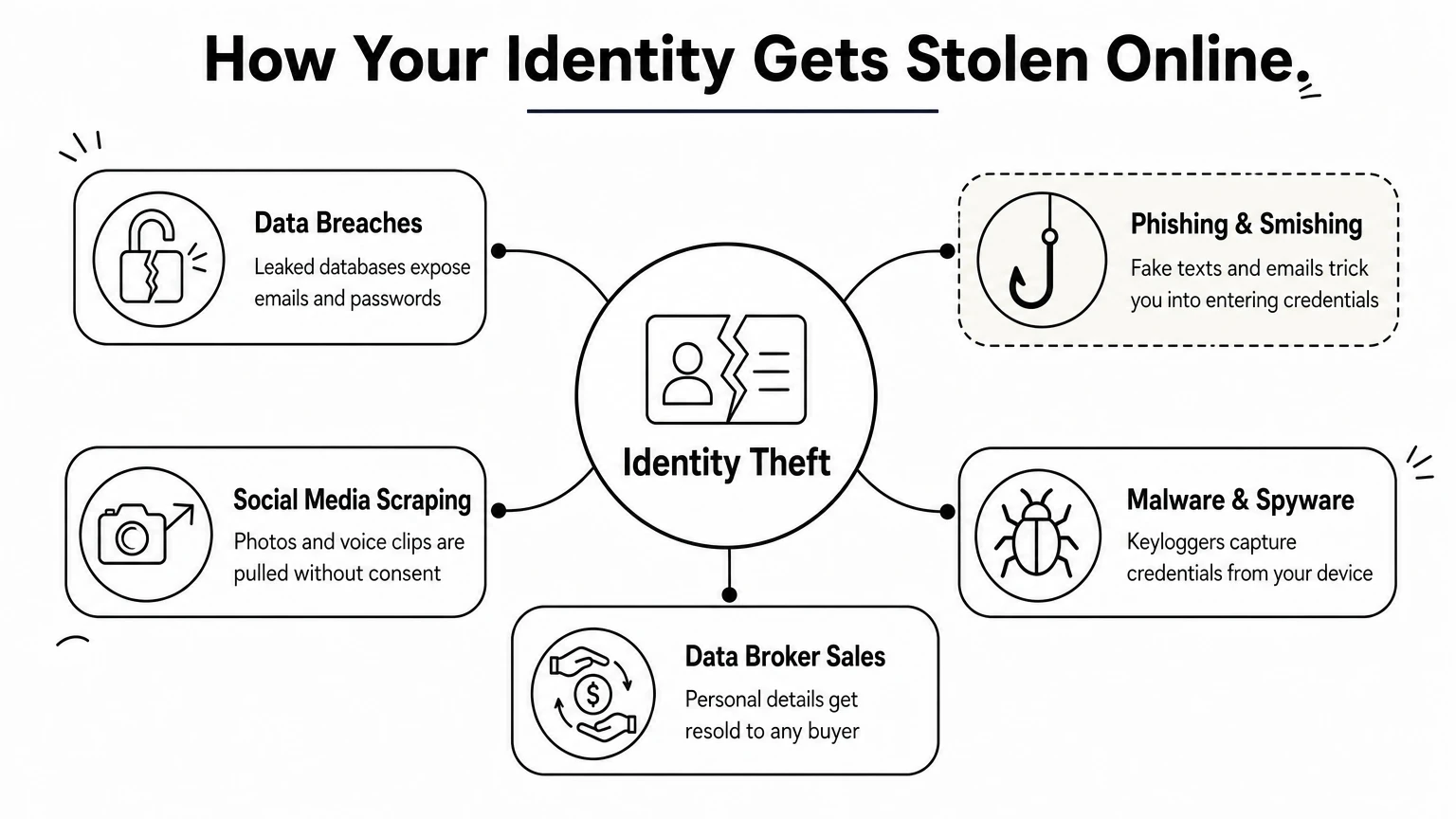
Understanding how does online identity theft happen in practice means looking at the specific entry points criminals use most:
Data breaches: leaked databases expose emails, passwords, and answers to security questions
Phishing and smishing: fake texts or emails trick you into entering credentials on cloned login pages
Public social media scraping: photos and voice clips get pulled without consent to train synthetic media models
Malware and spyware: keyloggers capture credentials directly from your device
Data broker sales: legally collected personal details get resold to whoever pays
Most identity theft doesn't start with a hack. It starts with something you already posted.
Once criminals combine even two or three of these sources, they can build a synthetic identity convincing enough to open credit accounts, pass employer verification, or scam someone who trusts your voice.
How to protect yourself from online identity theft
Lock down the basics first
Start with the fundamentals before worrying about deepfakes. Unique passwords stored in a password manager, two-factor authentication on every financial and email account, and a credit freeze with the three major bureaus close off the easiest entry points criminals use. Check your accounts against known breach databases and change any password that shows up compromised. None of this stops a cloned voice, but skipping it leaves the door wide open for the simpler attacks that still cause most reported losses.

Limit what you hand to AI systems
Every photo, voicemail greeting, and video call you post publicly becomes potential training material for someone else's synthetic media. Tighten your social media privacy settings, avoid posting long clips of your voice publicly, and think twice before joining apps that request facial scans for "fun" filters. These small habits reduce the raw material available to scrapers.
You can't undo a leaked photo, but you can control what you post next.
Establish proof of your own authenticity
Password hygiene protects your accounts, not your likeness. That's the gap the Human Authenticity Registry was built to close: a verified record tied to you, so you have documented proof when someone tries to pass off a deepfake as your voice or face. Registering takes minutes and gives you a reference point that didn't exist before AI-generated identities became common.
Freeze credit with all three bureaus
Enable 2FA everywhere possible
Audit public photos and voice clips
Register your HAR Identity as a verified baseline
Common examples of identity theft and how to respond
Real-world examples of identity theft online show how varied the attacks have become. A scammer clones a CEO's voice from a conference recording and calls the finance department requesting an urgent wire transfer. A fake LinkedIn profile uses your headshot and job history to apply for remote positions under your name. A deepfake video circulates showing you saying something you never said, sent to coworkers or family members to damage your reputation. Each scenario demands a different response, but speed matters in all of them.
Below is a quick reference for common attack types and the first move you should make.
Attack Type | First Response |
|---|---|
Voice cloning scam call | Hang up, verify by calling the person back on a known number |
Fake job application using your identity | Report to the platform, alert your actual employer |
Deepfake video impersonation | Document it, report to the platform, notify affected contacts |
Data breach exposing your info | Freeze credit, change passwords, monitor accounts |
The faster you document and report an impersonation, the faster you can prove it wasn't you.
Documentation matters more than people realize. Screenshot the fake profile, save the scam call log, and keep timestamps. Employers, banks, and platforms move faster when you arrive with evidence instead of just a claim. Having an existing verified identity record, like a HAR Identity, gives you a baseline to point to when disputing a fabricated video or voice clip that claims to be you.
Staying safe as identity theft evolves
Online identity theft keeps getting harder to spot because the tools behind it keep getting better. Passwords and credit freezes still matter, but they were never built to stop a cloned voice or a fabricated video. Knowing how identity theft occurs online helps you close the obvious gaps, but real protection means having proof that's yours alone, something no scraped photo or AI model can replicate.
Think of it this way: you lock your doors, but you also want a witness who can vouch it was really you at home. That's what a verified identity record gives you when someone tries to fake your face or voice. Waiting until after an incident to prove who you are puts you on the back foot every time.
Register now while it's still simple, and see why human authenticity matters in the age of AI as you join the founding members building this proof-first standard.