AI & Human Authenticity
Human-Centered Explainable AI: What It Is and Why It Matters
HAR Editorial Team

You've probably heard the term "explainable AI" thrown around in research papers and product pitches, but most of it still reads like an engineering checklist: feature importance scores, dec...
Human-Centered Explainable AI: What It Is and Why It Matters
You've probably heard the term "explainable AI" thrown around in research papers and product pitches, but most of it still reads like an engineering checklist: feature importance scores, decision trees, confidence intervals. That approach explains the math. It rarely explains anything to the person actually affected by the decision. Human centered explainable ai starts from a different question: what does a real person need to understand, trust, and act on an AI system's output?
This field, often shortened to HCXAI, treats explainability as a design problem rooted in human cognition and context, not just a technical output bolted onto a model. Instead of asking "can we generate an explanation," researchers in this space ask who needs the explanation, what decision they're making with it, and what would actually change their behavior or trust.
In this article, we'll walk through the core principles behind HCXAI, the research that shaped it, and how it diverges from traditional transparency methods that focus purely on algorithmic internals. We'll also connect this to a broader shift already underway: as AI reshapes how identity and authenticity get judged online, understanding who explanations serve, and why, matters more than ever.
Why human-centered explainable AI matters
Picture a hospital algorithm that flags a patient as high risk for readmission. The clinician sees a score of 0.82 and a list of contributing variables ranked by weight. That's technically an explanation, but it doesn't tell the doctor what to do next, whether to trust the score over her own judgment, or how to explain the decision to the patient sitting in front of her. This gap between technical output and human understanding is exactly why human centered explainable ai exists as its own field rather than a subset of machine learning engineering. Explanations that satisfy an auditor rarely satisfy a patient, a loan applicant, or a hiring manager, because those people are asking different questions entirely.
When explanations fail the people who need them
Research out of Microsoft Research and Carnegie Mellon has repeatedly found that feature-importance charts and SHAP values, while mathematically sound, often confuse non-expert users more than they clarify anything. A 2020 study on AI-assisted decision-making found that adding technical explanations sometimes made people trust incorrect model outputs more, not less, because the explanation looked rigorous even when the underlying reasoning was flawed. That's the core failure mode traditional explainability keeps running into: it optimizes for the appearance of transparency rather than actual comprehension.
An explanation nobody understands isn't transparency, it's decoration.
Different stakeholders need different explanations
Human-centered explainable ai treats this as a design constraint from the start. The same model decision needs to be explained differently depending on who's asking and why:
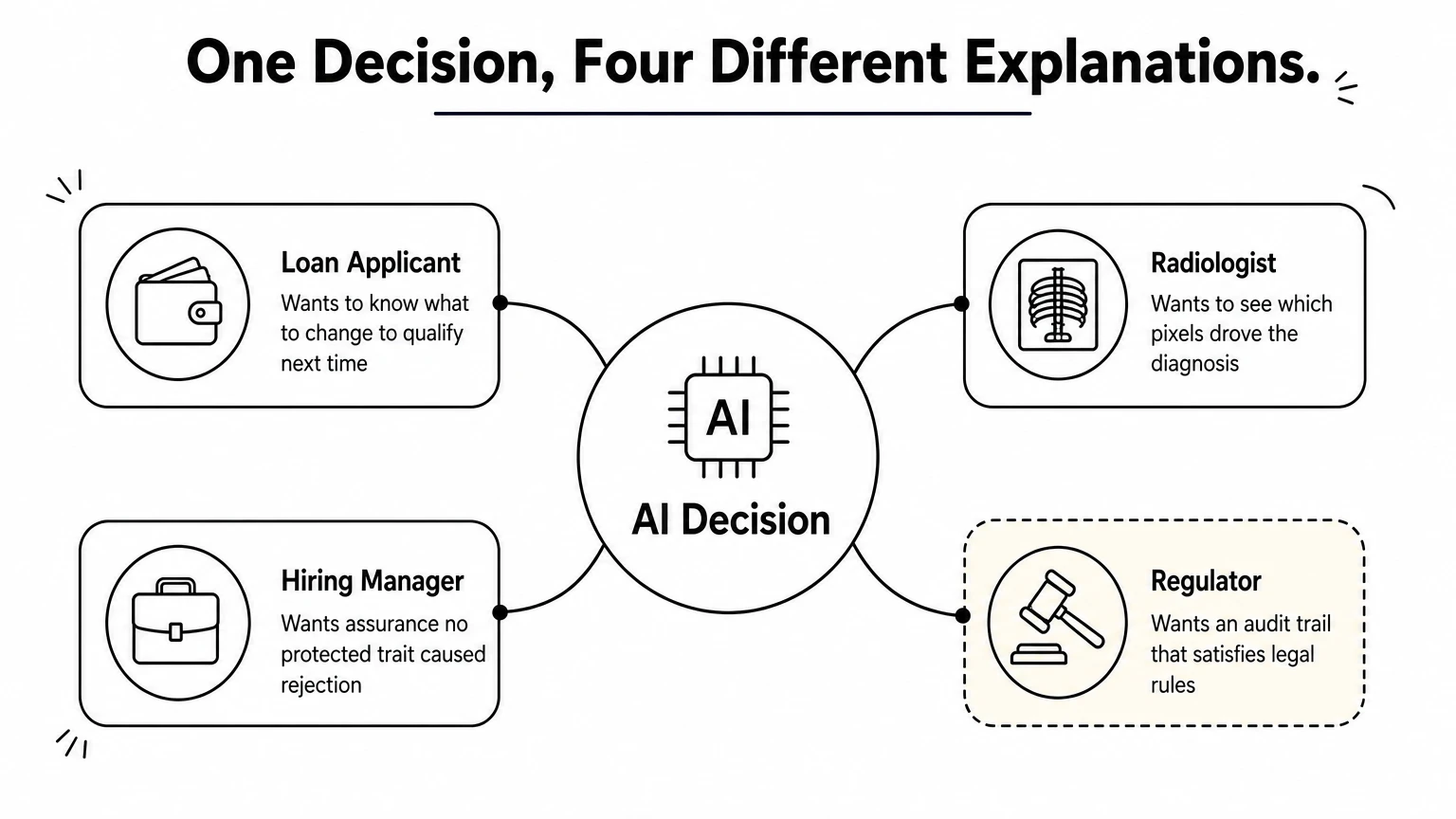
A loan applicant wants to know what to change to qualify next time, not the model's regularization parameters.
A radiologist wants to know which pixels or regions drove a diagnosis, so she can cross-check against her own read of the scan.
A hiring manager wants confidence that a candidate wasn't screened out for a protected characteristic disguised as a proxy variable.
A regulator wants an audit trail that satisfies legal accountability requirements, which looks nothing like what the applicant needs.
Questions like these expose why one-size-fits-all explainability tools keep underdelivering. A single dashboard built for data scientists can't simultaneously serve a compliance officer and a nurse, and pretending it can just pushes the confusion downstream to whoever has the least power to push back.
The stakes rise as AI touches identity and authenticity
Stakes get sharper still when the AI decision touches something as personal as identity. When a platform's detection system flags a video, a voice clip, or a profile photo as "likely AI-generated," the person on the receiving end needs more than a confidence percentage. They need to understand what triggered the flag, whether it can be contested, and what evidence would settle the question either way. This is precisely the terrain where authenticity, consent, and explainability start to overlap. Efforts like the Human Authenticity Registry exist because people increasingly need a way to proactively establish, on their own terms, that they are who they say they are, rather than waiting to be judged by an opaque detection system after the fact.
Understanding matters because trust doesn't come from having access to an explanation. It comes from an explanation actually landing, changing what someone believes or does next. That's the standard human centered explainable ai research holds itself to, and it's a much higher bar than "the model can technically produce a rationale." A rationale nobody can act on isn't accountability, it's a paper trail. As AI systems increasingly weigh in on questions of identity, hiring, credit, and healthcare, the gap between an explanation that satisfies engineers and one that satisfies the person affected becomes a question of basic fairness, not just usability. That's the shift this field is trying to formalize, and it's why the principles behind it deserve a closer look before you evaluate any AI system claiming to be "explainable."
How to apply human-centered principles in AI design
Turning HCXAI from a research paper into a working system means changing how you scope the project before you write a line of code. Most teams start with the model and bolt on an explanation layer at the end, treating it as a compliance checkbox. Human centered explainable ai flips that order: you start with the person who has to act on the output, then work backward to what the model needs to expose.
Start with the decision, not the dashboard
Before choosing SHAP, LIME, or any other technique, map out the actual decision the explanation supports. A loan officer rejecting an application needs different information than a data scientist debugging model drift, even though they're looking at the same underlying score. Ask three questions before building anything: What action will this person take next? What would make them trust or challenge the output? What happens if they get it wrong? Skipping this step is why so many explainability tools ship with technically accurate outputs that nobody downstream can actually use.
Test explanations on the people who'll actually use them
Engineers make poor test subjects for their own explanations, because they already understand the model. Usability testing with actual end users, patients, applicants, frontline staff, catches confusion that internal reviews miss every time. A 2019 study from IBM Research found that participants shown simplified, natural-language explanations made better decisions than those shown raw feature-importance scores, even though the simplified version contained less technical detail. Less information, presented in a way people could actually process, outperformed more information presented as a spreadsheet.
Explanations that pass an engineering review can still fail every person they were built for.
Build contestability into the system from day one
Beyond just being understandable, an explanation should give someone a path to push back. If a system flags a candidate's résumé or a user's identity as suspicious, there needs to be a clear mechanism to contest that judgment, not just a static readout of the model's confidence. Contestability turns explainability from a one-way broadcast into a two-way check on the system's authority, which is exactly what regulators and users both increasingly demand.
Match the explanation format to the stakes
High-stakes decisions warrant more detailed, more contestable explanations than low-stakes ones, and your design should reflect that gradient rather than applying one format everywhere.
Decision Type | Stakes | Explanation Format |
|---|---|---|
Movie recommendation | Low | Simple tag ("because you watched X") |
Credit denial | High | Actionable factors plus appeal path |
Medical risk score | High | Clinical rationale plus contestation route |
Content moderation flag | Medium-High | Reason plus review request option |
Getting this mapping right is less about picking the fanciest technique and more about respecting how much is riding on the answer.
Core principles that define human-centered XAI
Strip away the specific techniques and human centered explainable ai rests on a small set of principles that show up in nearly every serious research paper on the topic. These aren't abstract values, they're design constraints that determine whether an explanation actually works or just looks like it does.
Context before completeness
A complete explanation isn't the same as a useful one. HCXAI research consistently favors contextual relevance over exhaustive detail, meaning the explanation includes only what the specific person needs for their specific decision, not everything the model technically knows. Dumping every feature weight on a user isn't rigor, it's noise dressed up as transparency. A well-scoped explanation answers the question actually being asked instead of every question the model could theoretically answer.
Actionability as the real test
An explanation that doesn't change what someone can do next has failed, no matter how mathematically sound it is. This is why HCXAI treats actionability as a core requirement rather than a nice-to-have. If a rejected loan applicant reads an explanation and still has no idea what to change, the explanation didn't do its job. If a flagged user can't figure out what evidence would clear their name, the system isn't accountable, it's just documented.
If a person can't act on it, it isn't an explanation, it's a footnote.
Calibrated trust, not maximum trust
A subtler principle, and one traditional XAI often gets backwards, is that the goal isn't to make people trust the model more. It's to help them trust it the right amount. Calibrated trust means a person correctly identifies when the model is likely right and when it's likely wrong, rather than defaulting to blind faith because the interface looks technical. Research on this point is blunt: explanations that simply boost confidence without improving accuracy are actively harmful, because they make people worse at catching the model's mistakes.
Plurality over a single format
Good HCXAI systems don't assume one explanation style fits every user, so they build in plurality of formats from the start:
Plain-language summaries for general users
Visual highlights (like heatmaps) for domain experts scanning for anomalies
Structured audit trails for compliance and legal review
Comparative examples ("similar cases where the outcome differed") for people weighing an appeal
Offering multiple formats isn't redundant, it's the only way to serve genuinely different cognitive needs without forcing everyone through the same narrow lens.
Participatory design as an ongoing practice
Finally, HCXAI treats the people affected by a system as participants in its design, not just its eventual users. That means testing explanations with actual patients, applicants, or flagged users before deployment, and revising based on where they get confused, not just where engineers assume they will. Skipping this step is the single most common reason explainability tools pass internal review and still fail in the real world.
How human-centered XAI differs from traditional XAI
Traditional explainability research grew out of computer science departments trying to open the black box of a model, not out of studying how humans actually process information. That origin story explains a lot about where the two fields diverge. Traditional XAI treats explanation as a mathematical output: a set of feature weights, a saliency map, a decision boundary visualization. Human centered explainable ai treats explanation as a communication act between a system and a specific person, which means the same technically correct output can succeed or fail depending entirely on who's reading it.
Different starting questions
Ask a traditional XAI researcher what problem they're solving and you'll usually hear something like "how do we make the model's internal logic visible." Ask an HCXAI researcher the same question and the answer shifts to "how do we help this specific person make a better decision." That's not a small semantic difference. Model-centric transparency assumes that exposing internals is inherently valuable, regardless of whether anyone downstream can use what's exposed. Human-centered work rejects that assumption outright and insists explanations get evaluated by their effect on the recipient, not their fidelity to the model's math.
A perfectly accurate explanation that nobody can use is still a failed explanation.
Different measures of success
The two approaches also disagree on how you know an explanation worked. Traditional evaluation leans on metrics like fidelity (does the explanation match the model's actual reasoning) and sparsity (is it concise). HCXAI evaluation adds behavioral and cognitive measures that traditional methods rarely touch:
Dimension | Traditional XAI | Human-Centered XAI |
|---|---|---|
Primary goal | Reveal model internals | Support human decision-making |
Success metric | Fidelity, sparsity | Comprehension, appropriate trust |
Format | Fixed (charts, weights) | Adapted to audience and stakes |
Evaluation method | Technical benchmarks | User studies, task performance |
Treats trust as | Something to maximize | Something to calibrate |
Notice that fidelity still matters in HCXAI, an explanation shouldn't misrepresent the model. But fidelity alone was never a sufficient goal, and treating it as one is exactly how the field ended up producing technically rigorous explanations that confuse the very people they're supposed to serve.
Different relationships to trust
Perhaps the sharpest divergence shows up in how each field treats trust itself. Traditional approaches often implicitly assume more transparency automatically produces more (and better) trust. Human-centered work, backed by the same research on inflated confidence discussed earlier, treats trust as something that can be miscalibrated in either direction, and designs explicitly to correct that rather than just to add information. Rather than asking "how do we make people believe the model," HCXAI asks "how do we make sure belief tracks accuracy," which is a fundamentally different design target and one that requires understanding the person, not just the algorithm.
Real-world examples of human-centered explainable AI
Theory is useful, but the field earns its keep in deployed systems where real people have to act on an explanation, not just read one. Looking at actual implementations shows what changes when a team designs for the person receiving the explanation instead of the engineer producing it.

Clinical decision support that speaks the clinician's language
Several hospital systems piloting sepsis-risk models have moved away from raw probability scores toward explanations phrased around clinical reasoning: "elevated risk driven by rising lactate and heart rate over the last 4 hours," rather than a feature-importance table. That framing lets a nurse cross-check the explanation against what she's already observing at the bedside, instead of translating statistics into medicine herself. Human centered explainable ai in this setting means the output is built around the clinical workflow, not the model's internals.
The best explanation is the one that fits into how someone already makes decisions, not the one that forces them to learn a new language.
Lending explanations built around what applicants can change
Under the Equal Credit Opportunity Act, lenders in the US already have to give applicants specific reasons for a denial. The forward-looking versions of this requirement go further, pairing the mandated reason codes with plain-language, actionable guidance: pay down a specific balance, wait until a recent inquiry ages off the report, or correct a reporting error. That pairing is a textbook case of human-centered design layered on top of a compliance requirement. The regulation forces disclosure; HCXAI principles determine whether that disclosure actually helps the applicant do something differently next time.
Identity and authenticity flags that leave room to respond
As AI-generated faces, voices, and video become harder to spot, platforms are under pressure to flag suspected synthetic content quickly, but a bare confidence score doesn't tell a flagged person what to do next. Human-centered approaches to this problem pair a flag with a clear next step, showing what triggered it and offering a path to contest or verify identity directly. This is the exact gap that voluntary registries like the Human Authenticity Registry are built to close: rather than waiting to be misjudged by an opaque detector, someone can proactively establish a verified identity record and point to it when a system questions their authenticity. That's explainability working in reverse, giving a person the evidence before the dispute even starts.
Content moderation with a genuine appeal path
Social platforms that pair a moderation decision with a specific policy citation and a one-click appeal route see meaningfully different user behavior than platforms that just display "content removed." A few patterns show up repeatedly across these systems:
Specific policy reference instead of a generic violation notice
Visible evidence of what triggered the flag, such as the flagged clip or text segment
A working appeal button, not just a support email address
A response window, so the user knows when to expect resolution
Each of these design choices reflects the same underlying commitment: an explanation only counts if it changes what the recipient can do next.
Common challenges in building human-centered XAI
Building a genuinely human-centered explanation is harder than it sounds, and most teams underestimate the tradeoffs involved until they're deep into a project. Human centered explainable ai demands constant judgment calls between technical fidelity, cognitive load, and organizational pressure to ship something that merely looks compliant. None of these tensions have a clean fix, which is exactly why so many explainability efforts stall out somewhere between the research paper and the production system.

Simplicity versus accuracy
Every simplification risks distorting what the model actually did, and every attempt at full accuracy risks losing the reader entirely. Simplifying a model's reasoning into a single sentence like "denied due to credit history" is easy to understand but hides the interacting factors that actually drove the score. Pushing toward full technical accuracy solves that problem and creates a new one: nobody outside a data science team can parse it. Teams building HCXAI systems have to accept that some accuracy will always be traded away for comprehension, and the real skill is deciding how much, for whom, and when that tradeoff crosses a line into misleading.
There's no explanation that's simultaneously perfectly accurate and instantly understandable, so pick your tradeoff deliberately instead of by accident.
Designing for wildly different users
Audiences for the same explanation rarely share a baseline of technical literacy, and that gap is often invisible until testing exposes it. A hospital's sepsis-risk explanation might get read by an experienced ICU nurse, a first-year resident, and eventually a patient's family member, three people with almost nothing in common in how they process risk information. Cognitive diversity like this means one explanation format almost never works across a full user base, which pushes teams back toward the plurality-of-formats principle covered earlier, even when budget and timeline pressure argue for shipping a single version.
Testing at scale without a real budget for it
Usability testing with actual end users, patients, applicants, flagged accounts, is expensive and slow compared to running an automated fidelity benchmark. Most product roadmaps allocate time for the technical build and treat user testing as an afterthought squeezed in before launch, if it happens at all. Without that testing, teams end up guessing at what confuses people instead of measuring it, and guesses are exactly what got the field into the feature-importance-chart problem in the first place.
Incentives that quietly work against clarity
Organizations often have real, if unstated, reasons to prefer vague explanations over specific ones. A vague rejection reason limits legal exposure. A generic content-moderation notice avoids revealing detection methods to bad actors trying to game the system. Legitimate concerns like these are real, but they pull directly against the actionability and contestability that make an explanation useful, and resolving that tension takes deliberate policy choices, not just better interface design.
Where human-centered explainable AI is headed next
Regulation is quietly forcing the field's hand. The EU AI Act classifies many high-stakes systems, credit, hiring, medical devices, as requiring meaningful transparency to affected individuals, not just to auditors. That single shift pushes companies away from treating explainability as an internal compliance artifact and toward treating it as a genuine communication problem, because a regulator now checks whether the person on the receiving end actually understood the decision. Expect more jurisdictions to follow that model, since a technically compliant explanation nobody can parse is increasingly a legal liability, not just a UX complaint.
Personalized and adaptive explanations
Growth in this direction is coming from adaptive systems that adjust an explanation's format based on who's asking, rather than shipping one static version to everyone. Adaptive explanation systems are starting to appear in research prototypes that detect a user's technical background from prior interactions and shift automatically between plain-language summaries and detailed technical breakdowns. A version aimed at a data scientist auditing a model looks nothing like the version the same system shows a flagged user trying to understand a decision, and that's the point.
The next generation of explainable AI won't ask people to adapt to the explanation, it'll ask the explanation to adapt to the person.
Explainability meets identity verification
One of the more consequential shifts is happening at the intersection of explainability and identity itself. As synthetic media gets harder to distinguish from real content, the burden of proof is starting to move earlier in the process, before a dispute even happens, rather than sitting entirely with detection systems trying to explain a flag after the fact. Voluntary registries like the Human Authenticity Registry represent this shift concretely: instead of relying only on an AI system to explain why it flagged someone as suspicious, a person can hold a verified identity record that pre-empts the question altogether. That's a meaningfully different model of transparency, one built on proactive verification rather than reactive justification, and it fits squarely inside the values HCXAI research has been pushing for years.
Standardization pressure from research and industry
Standardization efforts are also gaining traction, with groups at institutions like NIST working on frameworks that define what a genuinely usable AI explanation should include, not just what a technically valid one contains. Watch for these efforts to formalize testing requirements, mandating that explanations get evaluated with real users before deployment, the same way usability testing became standard practice in software design more broadly. Combine that with tighter regulation and adaptive interfaces, and the trajectory becomes clear: explainability is moving from an engineering afterthought toward a design discipline in its own right, one measured by whether a real person walks away better equipped to trust, question, or act on what an AI system told them.
Putting people back at the center of AI
Strip away the jargon and human centered explainable ai comes down to one demand: an explanation should help a real person decide what to do next, not just prove a model did something defensible. That standard is harder to meet than a feature-importance chart, but it's the only one that actually holds up once regulators, patients, and flagged users start asking questions. The field's direction, adaptive formats, contestable decisions, and proactive verification instead of after-the-fact justification, all points toward the same shift: putting the person affected ahead of the system judging them.
That shift already extends beyond dashboards and denial letters into how identity itself gets verified online. If you'd rather establish your authenticity on your own terms than wait to be flagged by an opaque detector, see why human authenticity matters in the age of AI and become part of that founding effort.