AI & Human Authenticity
Proof of Humanity: What It Means and Why It Matters
HAR Editorial Team
Search proof of humanity and you'll land in two completely different worlds. One is a video game weapon in Lies of P, the giant hammer you swap for combat perks. The other is a real, growing category...
Proof of Humanity: What It Means and Why It Matters
Search proof of humanity and you'll land in two completely different worlds. One is a video game weapon in Lies of P, the giant hammer you swap for combat perks. The other is a real, growing category of technology built to answer a much bigger question: how do you tell a real person apart from an AI-generated one online?
If you're here for the game, the short answer is that Proof of Humanity is a heavy weapon type with slow but powerful attacks, and you'll want a different guide for build details. But if you landed here because you've been hearing the term in conversations about deepfakes, bots, and AI-generated faces flooding the internet, you're in the right place. This article breaks down what proof of humanity actually means in the identity and verification context, including the original blockchain-based Proof of Humanity protocol.
We'll walk through how these systems work, why they emerged, and what human verification looks like today, including newer, consent-first approaches like the Human Authenticity Registry, which let people voluntarily establish and control their own record of authenticity.
Why proof of humanity matters now
A decade ago, nobody needed to prove they were human online. CAPTCHA boxes and the occasional email confirmation were enough to keep out spam bots. That world is gone. Generative AI can now produce a photorealistic face, a convincing voice clip, or a full video of someone saying things they never said, all in seconds and often for free. The question of proof of humanity has moved from a niche cryptography concern to something ordinary people run into on dating apps, job boards, and social feeds every week.
The flood of synthetic content
Before this wave, most fake accounts were crude: stock photos, broken English, obvious bot behavior. Content generated by modern AI models doesn't have those tells anymore. A single person can spin up hundreds of synthetic personas, each with a unique face and voice, and use them to run scams, inflate follower counts, or manipulate public opinion. Platforms that once relied on manual moderation and pattern-matching are struggling to keep pace, because the fakes are improving faster than the detection tools built to catch them.
If a photo, a voice, and a resume can all be faked convincingly, the only reliable signal left is a person's own, voluntary claim to authenticity.
Why old verification methods fall short
Government ID uploads, phone number checks, and email confirmations were built for a different threat model, one where the main risk was a person lying about who they are, not a machine convincingly pretending to be a person at all. Those methods still matter, but they don't answer the newer question directly: is there a real human being behind this face, this voice, this profile? That gap is exactly why AI-generated identities have become such a persistent problem for platforms and individuals alike, and why a fresh category of tools has emerged specifically to close it.
Here's a quick look at how the two problems differ:
Old verification concern | New authenticity concern |
|---|---|
Is this person who they claim to be? | Is this a real person at all? |
Fake names, stolen documents | AI-generated faces, cloned voices |
Solved with ID checks, KYC | Solved with consent-based human registries |
One-time check at signup | Ongoing trust signal across platforms |
The stakes: trust, work, and identity
The consequences of getting this wrong reach well beyond annoying spam. Consider what's already happening:
Hiring managers report interviewing candidates on video calls who turn out to be deepfaked stand-ins for someone else entirely.
Romance scams increasingly use AI-generated faces and voices to build trust with victims over weeks or months.
Journalists and fact-checkers spend growing amounts of time verifying whether a viral video or image is real before reporting on it.
Remote workers face suspicion by default, even when they're entirely genuine, because bad actors have made every unfamiliar face a question mark.
Each of these situations shares a common thread: the burden of proof has shifted onto real people to demonstrate they're real, often with no easy way to do it. That's a strange and frustrating position for anyone who's simply trying to work, date, or communicate honestly online.
Meanwhile, regulators and researchers are paying attention. The Federal Trade Commission has flagged AI-enabled voice cloning and impersonation as an emerging consumer protection issue, and the trend line only points in one direction as generation tools get cheaper and better. Waiting for platforms or lawmakers to fully solve this isn't a realistic strategy for someone who needs to establish trust today.
This is where the idea of a voluntary, verifiable record of humanity starts to make practical sense. Instead of asking every platform to invent its own detection system, or hoping AI detection tools stay ahead of AI generation tools, individuals can build their own portable proof, once, and use it wherever it's needed. That's the premise behind projects like the Human Authenticity Registry, which lets people register as verified humans on their own terms rather than leaving the question to guesswork. Understanding what is proof of humanity in this identity sense, separate from any video game weapon of the same name, is the first step toward deciding whether a registry like this fits your own situation. The next section untangles that naming confusion for good, before we get into how these verification systems actually work.
Proof of humanity vs. the Lies of P weapon
Confusion around this term is understandable, because two completely unrelated products landed on the exact same name within a year of each other. Lies of P, the 2023 action RPG loosely based on Pinocchio, includes a heavy weapon called Proof of Humanity: a massive stone hammer with slow, high-damage swings favored by players who build around poise and heavy stagger. The identity-verification protocol with the same name has nothing to do with weapon crafting, boss fights, or combat perks. It's a coincidence of naming, not a shared origin, and mixing the two up in a search only wastes your time.
Where the name actually comes from
In Lies of P, Proof of Humanity fits into a broader theme running through the game: puppets striving to become real, breakable, mortal humans. The weapon's name is thematic flavor text, chosen because it fits the story, not because the developers were making any statement about AI or digital identity. If you're mid-playthrough looking for stats, moveset details, or where to find it, you'll want a gaming wiki or build guide, not an article about verification technology.
Why the identity meaning matters more right now
Meanwhile, the identity-verification sense of proof of humanity traces back to a 2021 blockchain project literally called Proof of Humanity, built to let people register as unique humans on Ethereum and prevent bots from claiming universal basic income tokens meant for real people. That original protocol used video submissions and a challenge period where other registered humans could dispute a fake submission. It introduced a real idea, that a network of humans vouching for each other could create a workable Sybil-resistant identity system, even though the specific blockchain implementation stayed niche.
One name, two products: a video game hammer and a real answer to AI-generated fakes, and only one of them matters if you're worried about deepfakes.
Searchers landing on this term today are almost always chasing the second meaning, not the first. Google Trends and general search behavior around AI, deepfakes, and identity verification have grown steadily since 2022, while gaming searches for the term stay tied to release windows and patch updates. That's a strong signal that when someone types "what is proof of humanity" without game-specific words attached, they're asking about the trust and identity problem, not build optimization.
Here's a side-by-side to settle any lingering confusion:
Aspect | Lies of P weapon | Identity verification concept |
|---|---|---|
Category | In-game heavy weapon | Human authenticity/verification method |
Purpose | Combat, stagger damage | Prove a real person exists behind an identity |
Origin | 2023 video game | 2021 blockchain protocol, now broader movement |
Where to learn more | Gaming wikis, build guides | Registries like the Human Authenticity Registry |
If you got this far, you're firmly in the second camp. The rest of this article sticks entirely to that meaning: how verification actually works, what it takes to get registered, and where the concept is showing up in real products today.
How proof of humanity verification works
At its core, proof of humanity verification tries to solve one narrow but hard problem: confirming that a specific digital identity is tied to one living, unique person, not a bot, not a duplicate account, and not a synthetic face generated by an AI model. Different systems solve this in different ways, but most modern approaches share a similar backbone, combining a biometric capture step with some form of ongoing consent management, rather than a single one-time check.
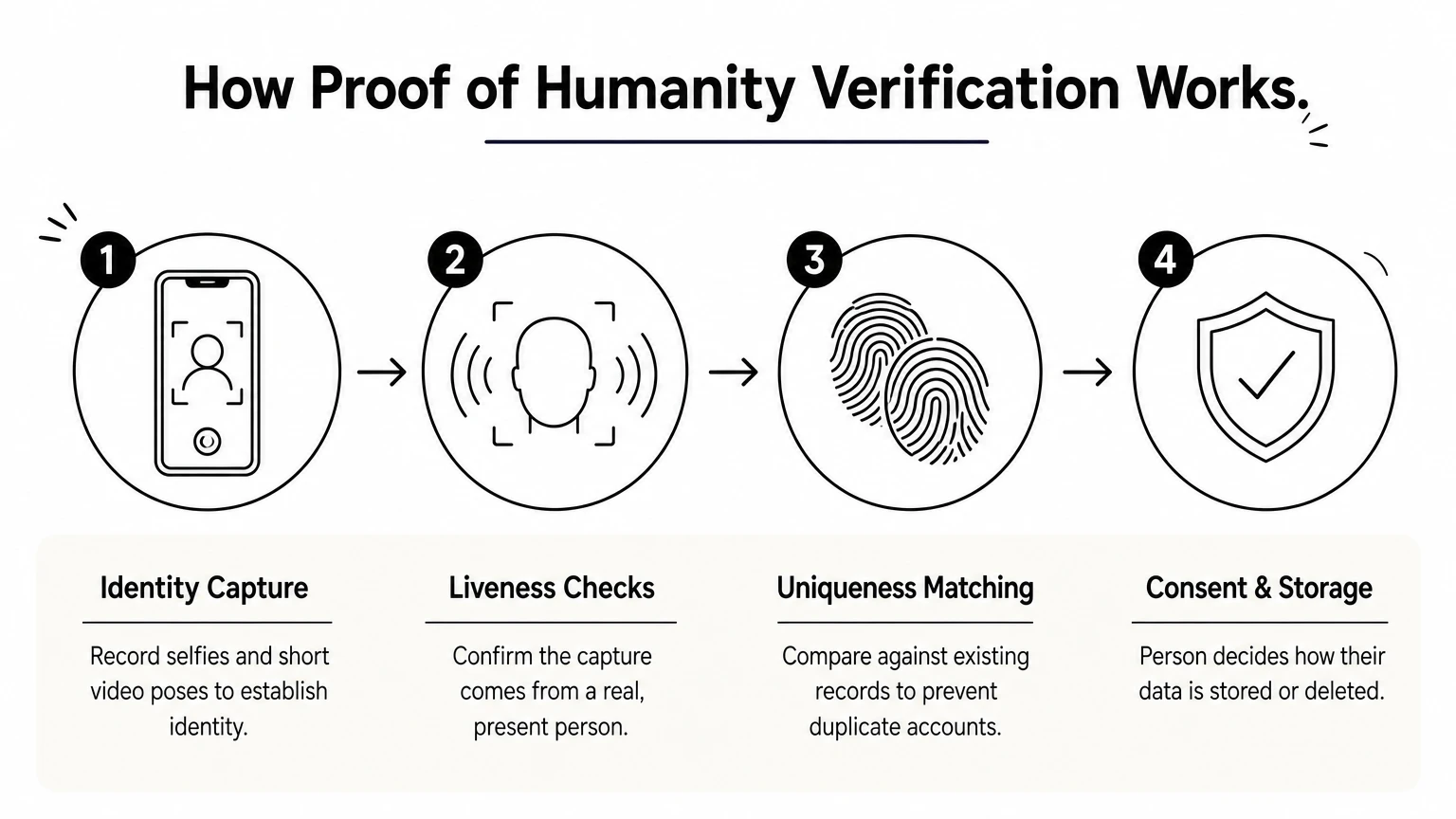
The core verification steps
Underneath the branding, most registries and protocols move through a similar sequence of steps. Here's what that typically looks like in practice:
Identity capture: The person completes a guided process, usually a series of selfies, short video clips, or head-turn poses captured on a smartphone, designed to record enough facial detail to establish a consistent identity.
Liveness checks: The system verifies the captures happened in real time from a real face, not from a photo held up to a camera or a pre-recorded video, which rules out the most obvious spoofing attempts.
Uniqueness matching: The system compares the new capture against existing records to make sure the same person hasn't already registered under a different identity, which is the step that prevents one individual from creating dozens of "verified" accounts.
Consent and storage decisions: The person decides what happens with their data going forward, including whether it can be deleted later, which distinguishes consent-first registries from older biometric databases that gave users little control.
Guided flows built around this sequence, like the one used by the Human Authenticity Registry, typically take five to ten minutes and rely on a set of roughly two dozen selfies and pose captures rather than a single photo, since a single image is far easier to fake or reuse than a full sequence.
A single photo can be faked in seconds; a full sequence of live poses is much harder to fake convincingly.
What makes these systems hard to fake
Sequential capture matters because deepfake generation still struggles with consistency across many angles and movements in real time. A generated face might look convincing in one still frame, but asking for a specific head turn, timed at the moment of capture, adds friction that's expensive for a bot to replicate at scale. This is why liveness detection, not just image comparison, has become the technical center of most human verification systems built after 2022.
Where the blockchain version differs
Worth noting: the original 2021 Proof of Humanity protocol handled uniqueness differently, using video submissions and a public dispute period where other registered humans could challenge a suspicious entry before it was accepted. That community-vetting model worked for a small, engaged user base, but it doesn't scale well to millions of everyday users who just want a quick, private way to establish authenticity. Newer registries have largely replaced public disputes with automated liveness and uniqueness checks, trading some of the original protocol's decentralization for speed and privacy.
What all these approaches share, blockchain-based or not, is the underlying goal: create a record that's specific enough to rule out AI generation, but controlled enough that the person being verified keeps a say in how their data gets used afterward. That balance, between rigorous verification and genuine consent, is what separates a trustworthy registry from a simple biometric database.
How to get verified through a proof of humanity registry
Getting verified through a modern proof of humanity registry looks nothing like the paperwork-heavy identity checks you might remember from opening a bank account. Most registries, including the Human Authenticity Registry, run the entire process on a smartphone, start to finish, without requiring a notary, a mailed document, or an in-person appointment. The goal is to make human verification something you can complete during a coffee break, not a bureaucratic errand you keep putting off.
What you need before you start
Before you begin, gather a few basics so the process goes smoothly on the first attempt. Registries built around live capture need decent lighting and a stable phone, since blurry or backlit footage forces retakes and slows down the liveness checks that keep the whole system honest.
A smartphone with a working front-facing camera
A quiet space with even, natural lighting (avoid strong backlighting from windows)
Roughly 5 to 10 minutes of uninterrupted time
A stable internet connection, since captures upload as you go
The verification steps
Once you have those basics ready, the flow itself follows a predictable sequence designed to be quick for you but hard for a bot or a synthetic face to fake. Registries vary slightly in wording, but the underlying steps look roughly like this:
Start the guided flow: Open the registration link on your phone and follow the on-screen prompts, which walk you through positioning your face in frame.
Complete the capture set: Follow prompts to turn your head through a series of angles while the system takes roughly two dozen selfies and short poses, building a record that's far harder to spoof than a single photo.
Pass the liveness and uniqueness checks: The system confirms the captures happened in real time and checks that you haven't already registered under a different profile.
Review the consent terms: Read through what data gets stored, how it's used, and what your deletion rights look like, then confirm you agree before submitting.
Receive your HAR Identity: Once processing finishes, you get a visible marker confirming your participation in the registry, along with Founding Member status if you register early.
A five-minute smartphone flow now does what a notarized document used to take days to accomplish.
After you're verified
Submitting your captures isn't the end of the relationship between you and the registry, and that's by design. Consent-first systems like the Human Authenticity Registry let you request data deletion later if you change your mind, rather than locking your biometric record into a system you can't exit. This matters especially for people weighing what is proof of humanity in practical terms: it's not a one-time transaction, it's an ongoing relationship where you keep some say over how your record gets used.
Registration also opens the door to what comes next. Early participants gain access to the evolving Trusted Community Network, a system built to extend recognized authenticity into new contexts as they emerge, from hiring to social platforms. Selective disclosure features let you share only what a specific situation actually requires, which matters if you're a remote worker trying to prove you're real without handing over your entire biometric history to every employer who asks.
Benefits and limitations of proof of humanity systems
No verification system is perfect, and proof of humanity registries are no exception. Weighing what these systems actually deliver against what they can't promise helps you decide whether registering makes sense for your own situation, rather than treating it as an obvious yes or no.
What these systems get right
Getting verified gives you something portable: a record of authenticity you control, rather than one owned by whatever platform you happened to sign up for that week. Instead of proving you're real over and over on every app, dating site, or job board, you build one credential and reuse it. That portability matters most for remote workers, who often face default suspicion simply because a hiring manager has never met them in person and has no easy way to rule out a deepfaked stand-in.
Faster trust-building: A verified record lets you skip repeated identity questioning on new platforms.
Selective disclosure: You share only what a situation requires, not your entire biometric history.
Consent and control: Systems like the Human Authenticity Registry let you request deletion later, unlike static biometric databases.
Community standing: Founding Member status and access to the Trusted Community Network reward early participants as the space matures.
Reduced fraud exposure: Liveness and uniqueness checks make it far harder for a bot or synthetic face to pose as you.
The value of a proof of humanity record isn't the badge itself, it's not having to re-prove you're real every single time someone asks.
Where these systems fall short
Registration doesn't erase every risk, and pretending otherwise would be dishonest. Adoption is still early, so a HAR Identity or similar credential only carries weight where the platform or person you're dealing with recognizes it, and plenty of major platforms haven't built that recognition in yet. Uploading biometric captures also means trusting a registry's storage and deletion practices, even a consent-first one, so the strength of that trust depends entirely on how transparent the operator is about its privacy policy. Nothing here replaces basic caution either: a verified badge tells someone you're a real person, not that you're trustworthy in every other sense, so scams built around emotional manipulation rather than fake identities can still succeed against a verified account.
Here's a quick summary of the trade-offs:
Benefit | Limitation |
|---|---|
Portable, reusable identity record | Only useful where platforms recognize it |
Selective disclosure protects privacy | Requires trusting the registry's data practices |
Deletion rights give ongoing control | Deletion doesn't undo prior disclosures already made |
Harder for bots to spoof | Doesn't guarantee good intent, only human origin |
Founding Member access to future networks | Long-term value depends on network growth |
Deciding if the trade-off is worth it
Thinking through this table honestly usually clarifies things quickly. If you're a remote worker tired of proving your existence to every new client, or someone who wants a voice in how authenticity standards get set before AI systems set them for you, the benefits tend to outweigh the current adoption gaps. If you're expecting instant, universal recognition everywhere online, you'll be disappointed, because that kind of standard doesn't exist yet for any registry, blockchain-based or otherwise. Understanding what is proof of humanity realistically offers, a useful but still-maturing tool, sets the right expectations before you commit five minutes of your time to the process.
Where proof of humanity is used today
Adoption of proof of humanity verification is still early, but it's no longer theoretical. You'll find some version of the concept showing up in dating safety features, freelance hiring platforms, journalism workflows, and a handful of blockchain identity projects that predate the current AI wave. None of these have become a universal standard yet, but each shows a different piece of the same underlying problem: proving a real, unique person sits behind a given profile or piece of content.

Dating and social platforms
Dating apps were among the first consumer platforms to feel the pain of AI-generated faces, since a convincing fake photo can run a romance scam for weeks before anyone notices. Several major apps have rolled out their own selfie-based verification badges for exactly this reason, though most rely on a single photo comparison rather than the fuller liveness checks used by dedicated registries. Social platforms face a related but broader version of the same issue: bot networks using synthetic faces to inflate engagement or push disinformation at scale, which is why platform trust and safety teams keep experimenting with stronger identity signals rather than removing accounts one at a time.
Hiring and remote work
Remote hiring has become one of the more urgent use cases, since a hiring manager who's never met a candidate in person has almost no way to rule out a deepfaked stand-in on a video call. Companies hiring internationally are starting to ask candidates for some form of verified identity credential before extending an offer, not because they distrust every applicant, but because a handful of well-publicized deepfake hiring scams have made caution the default. A HAR Identity or similar credential fits naturally into this workflow, since selective disclosure lets a candidate prove they're a real, unique person without handing over unrelated personal history the job doesn't require.
Content authentication and journalism
Journalists and fact-checkers now spend real time verifying whether a viral clip is genuine before running a story on it, and that verification burden is only growing as generation tools improve. Some newsrooms have started asking sources to attach a proof of humanity credential to submitted footage or interviews, treating it as one data point among several rather than a single silver-bullet fix. Fact-checking organizations and press freedom groups have both flagged synthetic media as a top emerging concern for accurate reporting.
Decentralized identity and blockchain projects
Before consumer-facing registries existed, blockchain projects were already experimenting with human verification to solve a narrower problem: preventing bots from claiming universal basic income tokens or governance votes meant for real people. The original 2021 Proof of Humanity protocol pioneered this space, and projects like Idena and BrightID built their own variations using different anti-Sybil mechanisms. World ID, tied to the Worldcoin project, took a biometric approach using iris scanning rather than facial capture.
No single platform has solved this problem alone; the pattern across dating apps, hiring, journalism, and blockchain projects is the same, real people need a portable way to prove they're real.
Each of these use cases points toward the same conclusion: authenticity verification works best as something a person carries with them, not something rebuilt from scratch by every platform they touch.
Deciding what proof of humanity means for you
By now, the two meanings of proof of humanity shouldn't overlap in your head anymore. One is a hammer in a video game. The other is a real, growing answer to a real problem: proving a person behind a face, a voice, or a profile is actually human, not generated. If you came here chasing build stats, you already know where to look next. If you came here worried about deepfakes, hiring scams, or your own online presence, the answer is more practical than philosophical.
Consider what you actually need: a portable, consent-based record you control, or continued reliance on platforms that are still catching up. Neither choice is wrong, but only one puts you ahead of the problem instead of reacting to it later.
If that sounds like the right move, register with the Human Authenticity Registry and claim your place as a Founding Member before the standard gets set without you.