AI & Human Authenticity
Online Shopping and Identity Theft: How to Protect Yourself
HAR Editorial Team
You add an item to your cart, type in your card number, and hit buy, all before finishing your coffee. That speed is exactly what makes online shopping and identity theft such a persistent problem. Ev...
Online Shopping and Identity Theft: How to Protect Yourself
You add an item to your cart, type in your card number, and hit buy, all before finishing your coffee. That speed is exactly what makes online shopping and identity theft such a persistent problem. Every checkout page you fill out adds another copy of your name, address, and card details to a database somewhere, and you have no real way of knowing how well that business protects it.
The good news: you can cut your risk sharply without giving up online shopping. This guide walks through the practical, specific steps that stop online purchases identity theft before it starts, from spotting fake checkout pages to knowing which payment methods actually shield your card number from a breach.
We'll also cover why fewer accounts and less shared personal data mean fewer places for your identity to leak from in the first place. That idea sits at the core of what we work on at HAR: giving people more control over what they disclose and to whom, rather than scattering personal details across every retailer that asks for them. Think of this as your checklist for shopping safely, one purchase at a time.
Why online shoppers are a top target for identity theft
Retailers collect more of your personal data than almost any other type of business you interact with regularly. A single checkout page can capture your full name, home address, phone number, email, and card details in under a minute, and that data often sits in databases that smaller merchants don't have the budget to secure properly. Criminals know this, which is why online shopping and identity theft show up together so often in fraud reports. The Federal Trade Commission logs hundreds of thousands of identity theft reports every year, and online shopping accounts are a recurring source.

Breaches at one retailer rarely stay contained to that retailer. Once your card number or login credentials leak, criminals test them across dozens of other sites, a technique called credential stuffing. That's how a breach at a small boutique site can end up draining your account on a completely unrelated platform months later.
The real danger of online shopping isn't one bad purchase, it's the trail of stored data you leave behind at every store you've ever checked out with.
The most common ways thieves exploit shoppers
Understanding the attack methods makes the defenses in this guide make sense:
Phishing emails disguised as shipping notifications or order confirmations
Fake checkout pages that mimic real retailers to harvest card numbers
Data breaches at legitimate stores that expose stored payment details
Account takeover using passwords reused across multiple shopping sites
Synthetic identity fraud, where stolen details get combined with fake information to open new accounts
Each method targets a different weak point, from your inbox to the retailer's server to your own password habits, which is exactly why a single fix, like a strong password, isn't enough on its own.
Step 1. Confirm a site is secure before you buy
Before you type a single card digit, check the address bar. A legitimate retailer uses HTTPS encryption, shown by a padlock icon and a URL that starts with "https://" rather than "http://". Skipping this check is one of the fastest ways to hand over your card details to a fake storefront.
Google's own Safe Browsing service flags known malicious sites, but it won't catch every knockoff clone, so you still need your own eyes on the page.
If a checkout page can't show you a padlock, it doesn't deserve your card number.
Quick checks before you enter payment info
Run through this list on any new retailer:
Confirm the URL is spelled correctly, not a lookalike domain
Look for a padlock icon and "https" in the address bar
Search the store name plus "reviews" or "scam" before buying
Check for a real physical address and working customer service contact
Avoid sites that pressure you with countdown timers or "only 1 left" banners
Trusting your gut matters here. If a deal seems too good or the site layout feels rushed and generic, treat that as a warning sign, not a bargain.
Step 2. Pay in ways that limit your exposure
How you pay matters as much as where you shop. Credit cards offer far stronger fraud protection than debit cards, since a fraudulent charge on credit is a dispute, while a fraudulent debit charge is money already gone from your checking account. Virtual card numbers, offered by many banks and services like Apple Pay or Google Pay, take this further by generating a one-time number for each purchase, so a breached retailer never actually holds your real card details.
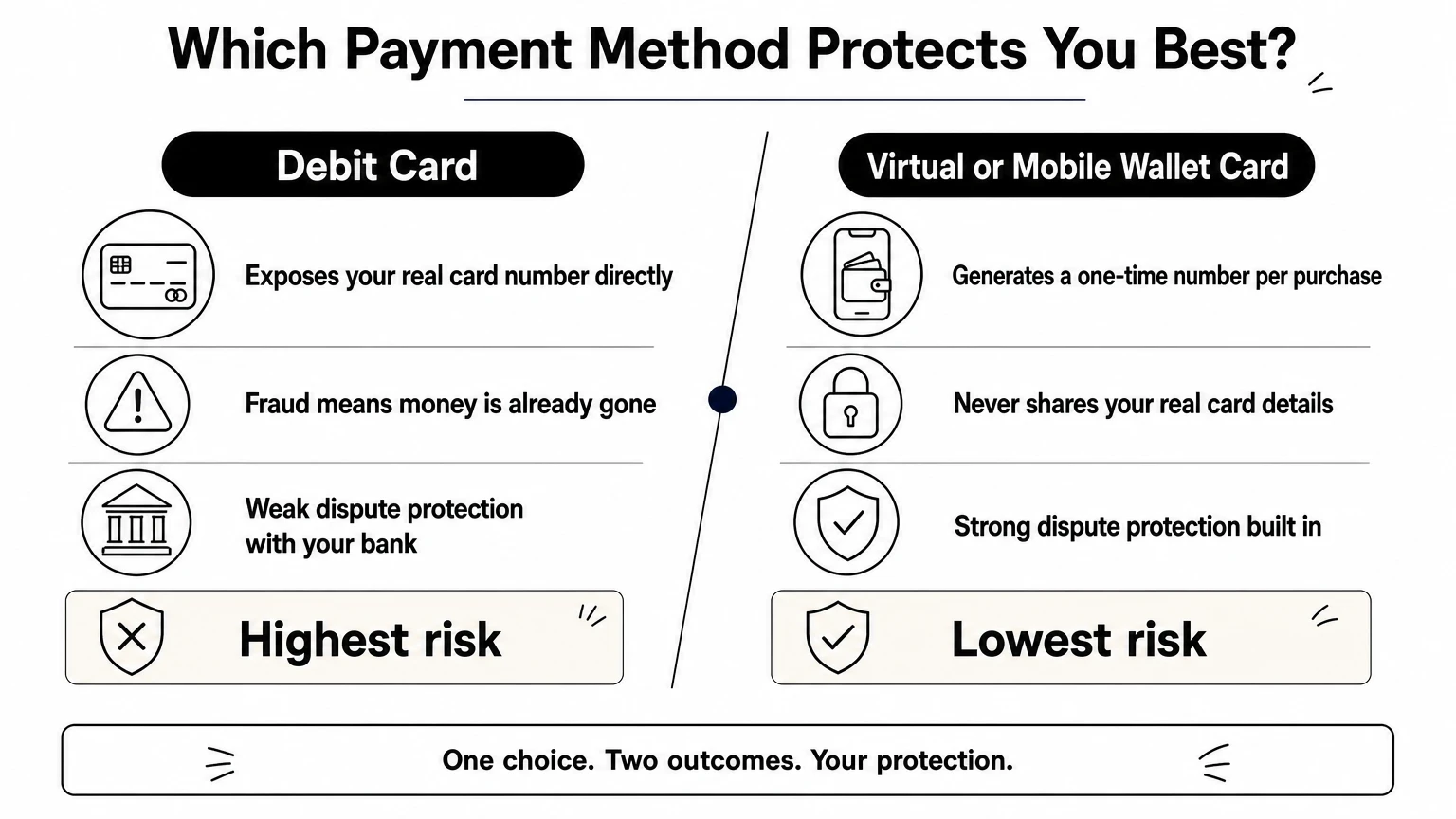
The safest payment method is the one that never exposes your real card number to the retailer at all.
Payment methods ranked by exposure risk
Method | Exposes real card number? | Dispute protection |
|---|---|---|
Debit card | Yes | Weak |
Standard credit card | Yes | Strong |
Virtual/one-time card | No | Strong |
Mobile wallet (Apple Pay, Google Pay) | No | Strong |
Gift card | No | None |
Skip storing your card on file with every retailer you use once. That saved-card convenience is exactly what turns a single breach into online purchases identity theft across accounts you forgot you even had.
Step 3. Lock down your accounts and passwords
Weak, reused passwords are the reason a breach at one retailer turns into a breach everywhere. If you use the same login for your favorite clothing site and your bank, one leaked database hands criminals the keys to both. A password manager solves this in minutes by generating and storing a unique password for every account, so you never have to remember or reuse one again.
A password you reuse across stores is a password you've already given away.
Habits that actually stop account takeover
Build these into your routine, not just your memory:
Turn on two-factor authentication wherever a retailer offers it
Use a password manager instead of variations of the same phrase
Delete old shopping accounts you no longer use
Avoid saving your address and card together in "guest" accounts that persist
Review connected apps and third-party logins tied to your email
Every dormant account is another place your data can leak from without you noticing. Fewer accounts also means fewer places asking for information a purchase doesn't actually require, which is the same selective-disclosure principle behind how HAR approaches identity online.
Step 4. Watch for warning signs and act fast if scammed
Even careful shoppers get hit, so speed matters more than perfection once something looks wrong. Unfamiliar charges, an order confirmation for something you never bought, or a password reset email you didn't request are all early signals that your information leaked somewhere. Waiting a few days to "see if it's nothing" is how a small problem turns into full-blown online purchases identity theft spread across multiple accounts.
Fast action limits the damage far more than any prevention step alone. Report suspicious charges to your card issuer immediately and ask for a new card number rather than a simple dispute. Freeze your credit through all three bureaus if you suspect broader exposure, not just a single stolen card.
The five minutes you spend reporting a stolen card today saves the months you'd spend untangling fraud later.
What to do the moment you notice fraud
Call your card issuer or bank and report the charge right away
Change the password on the affected account and any reused elsewhere
Place a fraud alert or credit freeze with Equifax, Experian, and TransUnion
File a report at IdentityTheft.gov to get a recovery plan
Monitor your statements weekly for a few months afterward
Making safe online shopping a habit
None of these steps require special technical skill, just consistency. Checking for HTTPS, paying with a credit card or virtual number, using a password manager, and reacting fast to warning signs together close most of the gaps that turn a routine purchase into online shopping and identity theft. The habit matters more than any single fix, since criminals only need one weak point to get in.
Zoom out, though, and the bigger issue is how much personal data you scatter across retailers in the first place. Every account you create is another place your name, address, and card details can leak from later. That's the problem HAR was built around: giving you selective disclosure over what you share, so your identity isn't sitting exposed in a dozen databases you've long forgotten about. If that idea resonates, read more about the dangers of identity theft online, then join the Human Authenticity Registry and take a real step toward controlling your own data trail.