AI & Human Authenticity
Deepfake Audio Detection: How to Spot an AI-Cloned Voice
HAR Editorial Team

You get a call that sounds exactly like your CEO, your mom, or your business partner, asking for money or sensitive information right now. Voice cloning tools have gotten good enough that a few second...
Deepfake Audio Detection: How to Spot an AI-Cloned Voice
You get a call that sounds exactly like your CEO, your mom, or your business partner, asking for money or sensitive information right now. Voice cloning tools have gotten good enough that a few seconds of audio can produce a convincing fake, and your ears alone can't always catch it anymore. Deepfake audio detection is the set of tools and techniques built to close that gap, and it's become a practical skill rather than a niche research topic.
This article breaks down exactly how audio deepfake detection works: the acoustic tells that give away synthetic speech, the software and models researchers and companies use to flag cloned voices, and the datasets that train those detectors to keep improving as cloning tech advances. You'll also see where current tools fall short, because no detector catches everything yet.
We built the Human Authenticity Registry because verifying what's genuinely human matters more every year, and voice is one more identity marker AI can now fake convincingly. Understanding detection methods and knowing their limits helps you protect yourself, your family, and your work from a threat that's only getting more sophisticated.
Why audio deepfake detection matters right now
Voice cloning used to require hours of studio-quality audio and specialized software. Now a three-second clip pulled from a voicemail, a podcast, or a social media video is enough to generate a convincing clone. That shift changed audio deepfakes from a novelty into a working criminal tool, and it's why deepfake audio detection has moved from academic labs into everyday security conversations for families and businesses alike.
Real scams, real losses
Criminals already use cloned voices to impersonate executives, grandchildren, and government officials. The FBI's Internet Crime Complaint Center has flagged AI-enabled voice fraud as a growing category in its annual reports, and the pattern is consistent: a caller sounds panicked or urgent, references real names or details scraped from social media, and pressures the target to act before they can verify anything. Common scenarios include:
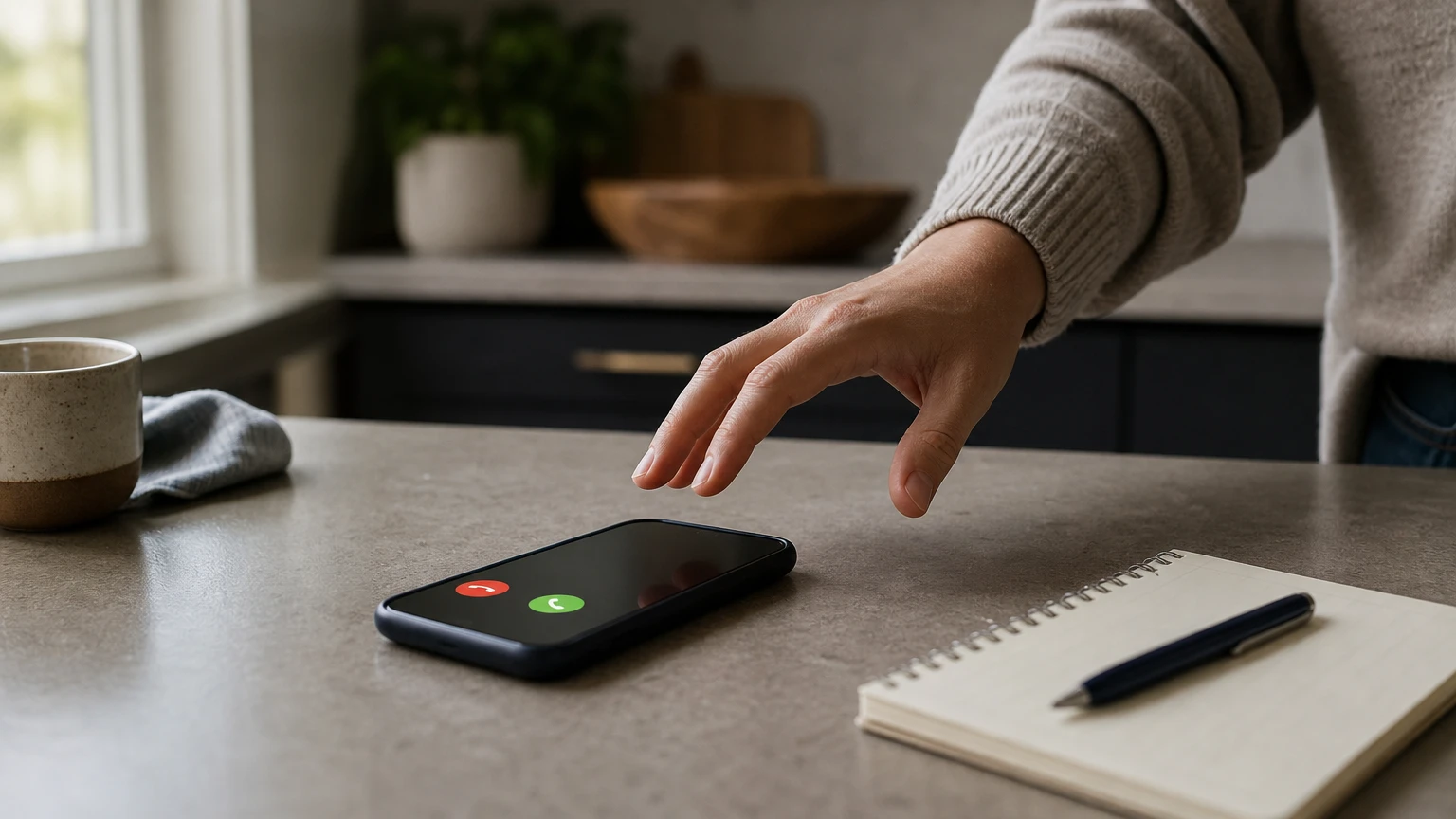
A fake "CEO" instructing an employee to wire funds immediately
A cloned "family member" claiming to be in jail or in an accident
A synthetic voicemail from a "bank representative" requesting account details
A spoofed customer call designed to bypass voice-based authentication
Each of these depends on the same weakness: people trust a familiar voice more than they trust a written message, and scammers know it.
Your ears can't keep up
Humans evolved to recognize voices, not to audit them for synthetic artifacts. Modern cloning models smooth over the pitch inconsistencies and robotic cadence that used to give fakes away, so a casual listener on a phone call has almost no chance of spotting a well-made clone in real time.
If a voice sounds right, that's no longer proof it's real.
Studies on human perception of synthetic speech consistently show that listeners perform close to chance when judging short clips, especially over compressed phone audio where subtle artifacts get stripped out entirely. That's exactly why audio deepfake detection tools exist: they analyze frequency patterns, breathing rhythms, and spectral consistency that a human ear simply can't process fast enough or precisely enough.
The scale is exploding
Generating a synthetic voice used to take real effort. Now it's a commodity, and the numbers show how fast the problem is growing.
Year | Audio needed to clone a voice | Typical cost/access |
|---|---|---|
2019 | 30+ minutes of clean audio | Research-grade software, technical skill required |
2022 | 1-2 minutes | Consumer apps, subscription pricing |
2025 | 3-10 seconds | Free or low-cost apps, no technical skill needed |
As the barrier to entry drops, the volume of attempted fraud rises with it. Detection tools that once served researchers and journalists verifying suspicious clips now matter to anyone with a phone number, a public social media profile, or a business that handles money over the phone. That's the backdrop for the rest of this guide: practical steps, red flags, and software you can actually use.
How to detect deepfake audio step by step
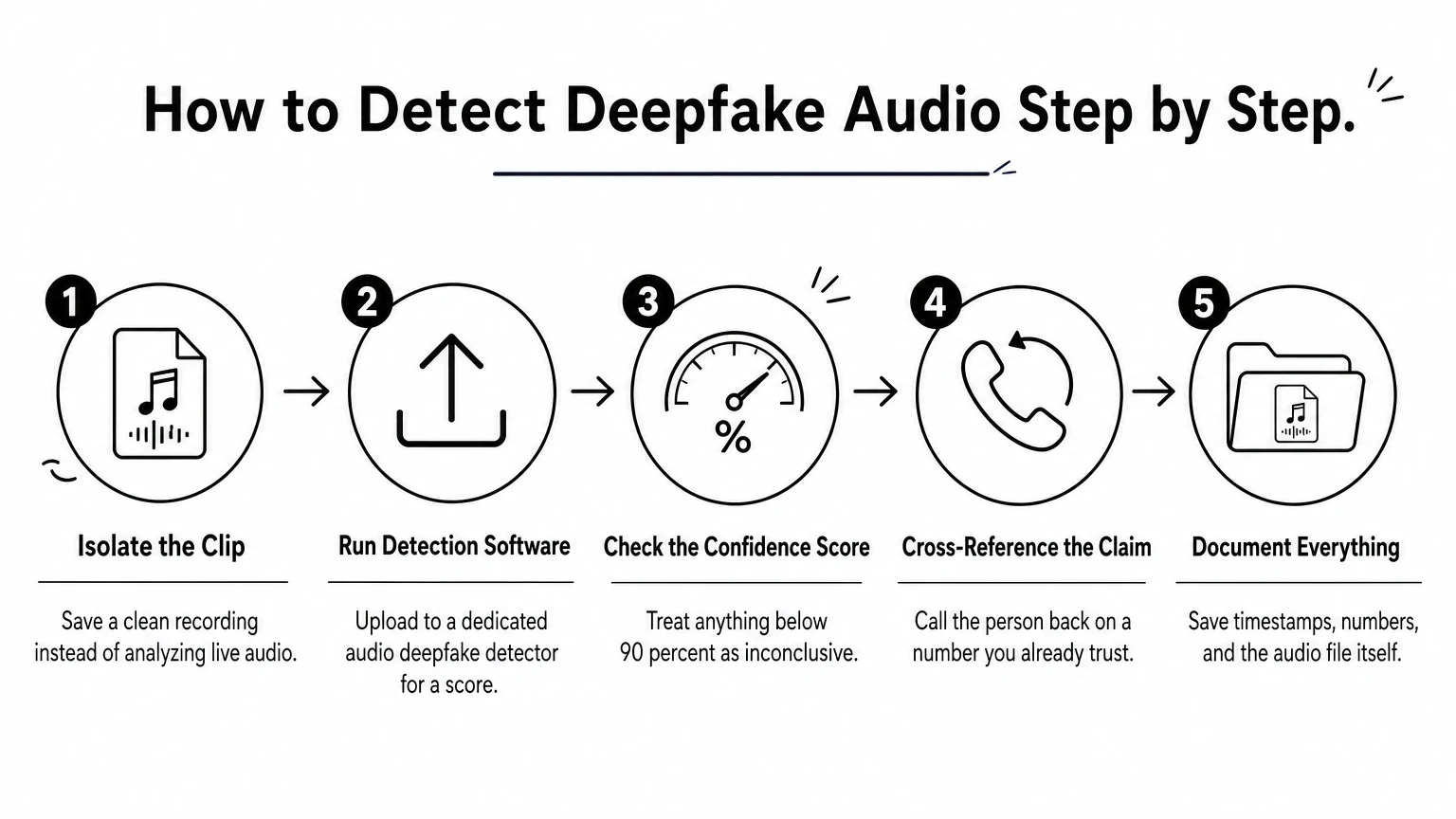
When you suspect a voice on the other end isn't real, you need a repeatable process, not a gut check. Deepfake audio detection works best as a sequence: isolate the clip, run it through analysis, and cross-check against other evidence before you act on anything the caller asked for.
Start with the clip itself
Before you touch any software, get the cleanest version of the audio you can. A screen recording of a video call, a saved voicemail, or a downloaded clip all work better than trying to analyze audio while it's still playing live. Isolating the file gives detection tools a stable sample to work with instead of a moving target.
Run the detection workflow
Once you have the file, work through these steps in order:
Upload the clip to a dedicated audio deepfake detector rather than a general AI-content checker, since voice artifacts differ from text or image ones.
Check the confidence score the tool returns, and treat anything below 90% certainty as inconclusive rather than a clean pass.
Listen for pacing anomalies the software flags, like unnatural pauses or breath sounds that repeat identically across the clip.
Cross-reference the claim independently. Call the person back on a known number, not the one that contacted you.
Document everything including timestamps, the caller's number, and the audio file itself, in case you need to report fraud later.
No single scan replaces calling the person back on a number you already trust.
Verify before you trust
Even with a clean detection result, treat the score as one data point rather than a verdict. Detection models miss newer cloning techniques they weren't trained on, so a "likely real" result doesn't guarantee authenticity. Pair the technical check with a human step: ask the caller something only the real person would know, or request they verify through a separate channel like a video call, though you should also know how to detect a deepfake video call, or a pre-agreed passphrase.
Audio deepfake detection tools give you evidence, not certainty. Combining a software scan with basic verification habits, like callback confirmation and shared family passphrases, closes most of the gap that scammers rely on when they impersonate a trusted voice.
Red flags that reveal an AI-cloned voice
Even the best cloning tools leave traces, and training your ear to notice them buys you time before you act on a scammer's request. Deepfake audio detection software catches artifacts humans miss, but you can flag a lot of fakes yourself just by listening for the seams AI still struggles to hide.
Acoustic tells your ear can catch
Listen closely to the texture of the voice, not just the words. Cloned audio tends to share a specific set of flaws:
Flat emotional range that doesn't match the supposed urgency of the message
Missing breath sounds or breathing that repeats in an identical pattern
Unnatural pacing, with pauses landing in odd places or words running together
Background noise that's too clean, since cloning models often strip ambient sound entirely
Metallic or watery artifacts during sibilant sounds like "s" and "sh"
A voice with no breath, no hesitation, and no background noise is a voice worth doubting.
Behavioral red flags beyond the audio
Beyond the sound itself, notice how the conversation is being steered. Scammers using cloned voices almost always create pressure to skip verification, whether that's insisting you can't hang up, refusing a callback, or demanding you switch to a payment method that's hard to trace like gift cards or crypto. Genuine emergencies rarely require you to act within minutes, and a caller who resists a simple verification step is telling you something important.
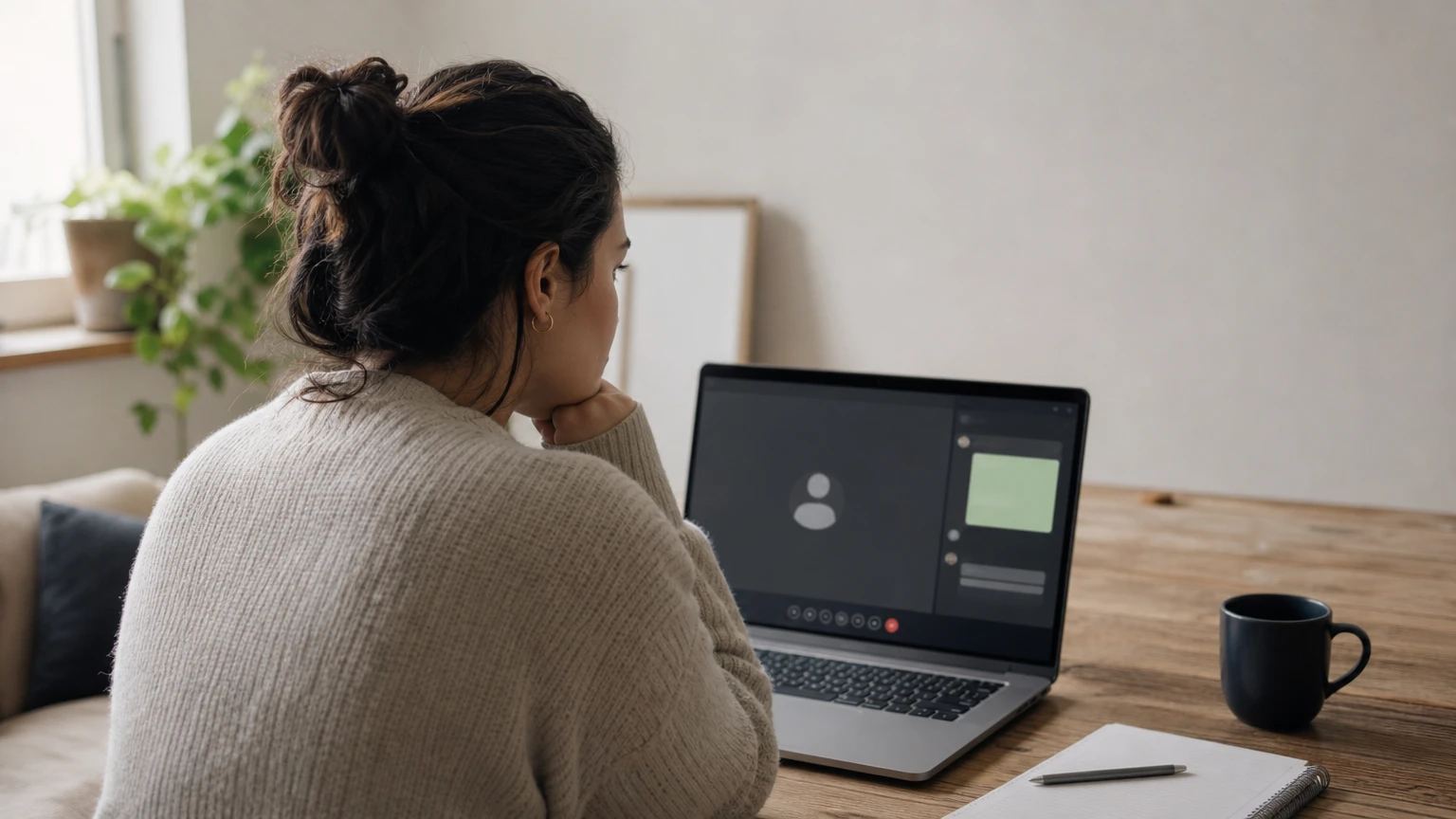
Callers relying on cloned audio also tend to avoid video. If someone claiming to be a family member or executive won't jump on a quick video call, or their camera conveniently "isn't working," treat that refusal as a signal on its own. Real people in genuine emergencies rarely object to proving who they are, especially when you offer an easy way to do it.
Combining these behavioral flags with the acoustic ones gives you a fuller picture than either alone. A slightly odd pause might mean nothing on its own, but paired with refusal to video chat and a demand for immediate payment, it points toward a scam using audio deepfake detection you can perform without any software at all.
Top tools and software for spotting fake voices
You don't need a computer science degree to run a deepfake audio detection scan, but you do need to know which tools actually work and where each one fits. The market splits into three tiers: consumer apps built for quick checks, research-grade models built for accuracy, and enterprise platforms built for call centers and fraud teams handling thousands of calls a day.
Consumer and prosumer detectors
Apps aimed at everyday users trade some accuracy for speed and simplicity. You upload a clip, wait a few seconds, and get a percentage score telling you how likely the audio is synthetic. These tools work well as a first pass on a suspicious voicemail or video, but they struggle with short clips under five seconds and heavily compressed phone audio, exactly the conditions scammers exploit.
Research-grade and enterprise platforms
Academic labs and specialized security vendors build detectors trained on massive datasets of both real and synthetic speech, and they tend to outperform consumer apps on tricky cases. Enterprise platforms built for banks and call centers go further, analyzing call metadata alongside the audio itself, things like call routing patterns and device fingerprints, to catch fraud that a pure audio scan would miss.
The right tool depends on what you're protecting, not which one has the flashiest interface.
Comparing your options
Tool type | Best for | Typical accuracy | Speed |
|---|---|---|---|
Consumer apps | Quick personal checks | Moderate | Seconds |
Research models | Investigative or legal work | High | Minutes |
Enterprise platforms | Call centers, banks | High, with metadata | Real-time |
What to look for before you trust a score
When you're choosing audio deepfake detection software, prioritize tools that publish their training data and accuracy rates rather than ones that just claim to be "AI-powered." A transparent vendor will tell you which cloning methods it struggles against, since no detector catches every generation technique. Look for tools that let you download a report with timestamps and confidence intervals, not just a single pass or fail label, because that documentation matters if you ever need to report the incident or escalate it to a fraud team.
Why detection alone can't stop every deepfake
Even the best deepfake audio detection tool only tells you what already happened, not what's coming next. Detectors get trained on existing cloning methods, and by the time a new generation model ships, the detector is already a step behind. That gap isn't a bug in any one product, it's baked into how detection works.
The arms race never ends
Cloning tools improve constantly, and each improvement targets the exact artifacts detectors rely on: pitch variance, breath timing, spectral noise. Researchers publish a detection method, cloning developers patch around it within months, and the cycle restarts. Voice fraud researchers describe this pattern as adversarial, meaning every fix invites a counter-fix. A detector that catches 95% of clips from last year's models might miss half of this year's, and you have no reliable way to know which category the clip in front of you falls into.
A detector built on yesterday's clones can't promise anything about tomorrow's.
Detection happens too late to prevent damage
By the time you run a clip through a scanner, the call has usually already happened. Wire transfers get sent, passwords get shared, trust gets exploited, all before anyone thinks to check the audio. Audio deepfake detection works best as a verification step after the fact or a screening tool before you act, not as a real-time shield during a live phone call where a scammer is pressuring you to move fast.
No universal standard exists yet
Different tools use different training data, different thresholds, and different definitions of "synthetic," so two detectors can score the same clip differently. Some limitations to keep in mind:
Detectors trained mostly on English speech underperform on other languages
Heavily compressed phone audio strips artifacts detectors depend on
Newer open-source cloning models often aren't represented in training sets yet
That inconsistency is exactly why organizations like the Human Authenticity Registry focus on verifying the human behind an identity upfront, rather than betting everything on catching a fake after it's already circulating.
Protecting your identity beyond detection tools
Detection tools only work after a clone already exists, so real protection means shrinking how much cloneable audio of your voice is floating around and putting a verified record of your identity in place before someone tries to fake it. Think of deepfake audio detection as your last line of defense, not your first one. The habits below matter more day to day than any scanner you run after the fact.
Limit the audio you leave behind
Guard your voice the way you'd guard a password, because it is one more entry point among the dangers of identity theft online. Every public podcast appearance, unlisted YouTube video, or long voicemail greeting hands cloning tools more raw material to work with. Small changes cut that exposure fast:
Shorten voicemail greetings to a few generic words instead of your full name and number
Set old public videos and livestreams to private when you no longer need them visible
Avoid posting long, clear audio clips of yourself on open social platforms
Set up verification habits with people you trust
Getting ahead of a scam beats reacting to one. Agree on a shared family passphrase with parents, kids, and close coworkers now, before anyone's under pressure on a call. Pick a callback number you'll use no matter what number contacted you, and treat any request to skip that step as a red flag on its own.
The strongest defense against a cloned voice is a verification habit you built before you needed it.
Register your authentic identity upfront
Instead of waiting to prove a fake wrong, some people are choosing to prove the real thing right from the start. The Human Authenticity Registry lets you complete a short, guided verification and hold a public marker that confirms you're a real, consenting human behind your identity, with selective disclosure so you only reveal what a situation actually requires. Founding members shape how that standard gets built, rather than inheriting rules set later by AI systems or platforms that never asked them. Combined with tighter audio habits and a family passphrase, that upfront record gives you a layer of protection detection software alone can't offer.
Staying ahead of the cloned voice era
Cloned voices aren't going away, and the tools that make them keep getting cheaper and faster. Deepfake audio detection gives you a real way to catch a fake before it costs you money or trust, but no scanner catches everything. The strongest position combines all three layers: run suspicious clips through a detector, train your ear on the acoustic and behavioral red flags, and lock in verification habits like callback numbers and family passphrases before you ever need them.
Detection reacts to fakes that already exist. Proactive verification flips that script by proving who you are before anyone tries to clone you. That's the gap the Human Authenticity Registry was built to close. Take five minutes to establish your proof of humanity with the Human Authenticity Registry and put a verified, consent-first record of yourself in place while the cloned voice era is still figuring out its next move.